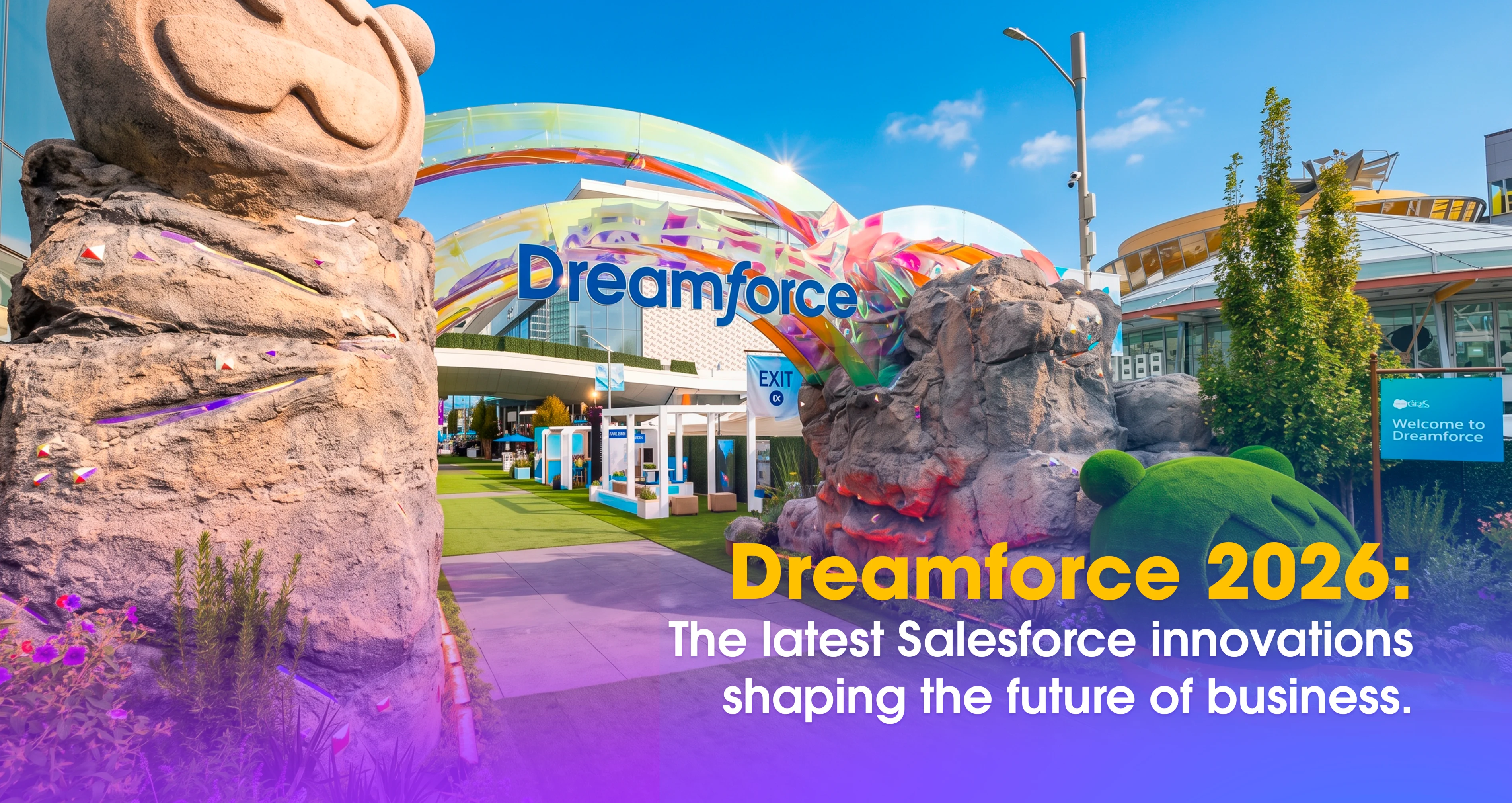
More than 50,000 people participated in person, while over 122,000 followed the event via Salesforce+ from more than 150 countries.
Dreamforce 2026 may be over, but it marked one of the most significant transformations in the Salesforce ecosystem in recent years.
From September 15–17, San Francisco once again became the center of conversations about CRM, data, automation, and artificial intelligence. More than 50,000 people attended in person, while over 122,000 joined through Salesforce+ from more than 150 countries.
Beyond the numbers, Dreamforce 2026 delivered a particularly important message for businesses: we are moving from using artificial intelligence to generate answers to using AI to perform real work.
AI agents are no longer presented simply as assistants capable of chatting with customers or employees. Salesforce is building an architecture in which agents can understand business context, reason through complex situations, execute actions across different systems, and collaborate with people and other agents.
That is why concepts such as AIforce, Agentforce, Claudeforce, Agentforce Coworker, Data 360, Koa, Slackforce, AgentExchange, and Enterprise AI Harness dominated the conversation.
At Xentric 360, we have gathered the most important announcements and trends from Dreamforce 2026 to explain what happened during the event and, more importantly, what these innovations could mean for businesses across the Caribbean.
From Generative AI to the Agentic Enterprise
Over the past few years, we have witnessed the rapid adoption of generative artificial intelligence in business environments.
Initially, organizations used AI to generate content, summarize documents, and answer questions. Then came AI copilots, capable of accessing business information and assisting employees with everyday tasks.
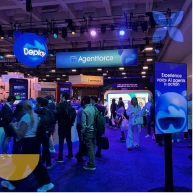
An organization in which humans and AI agents work together to achieve business goals.
Dreamforce 2026 introduced the next step.
Salesforce calls it the Agentic Enterprise: an organization where people and AI agents work together to achieve business objectives.
The difference may seem subtle, but its implications are enormous.
A traditional chatbot answers a question.
A copilot helps a person complete a task.
An AI agent can receive an objective, analyze information, determine which steps to take, use tools, update systems, communicate with other agents, and continue working until the desired outcome is achieved.
Salesforce announced that approximately 7 billion Agentic Work Units (AWUs) had been processed through Agentforce and Slack over the previous two years, signaling a shift from experimental pilots toward real enterprise deployments.
However, Dreamforce 2026 also made one thing clear: introducing AI agents into a business requires much more than connecting a language model to company data.
Agents need context, permissions, integration, security, and governance.
And that brings us to one of the event’s most important announcements.
AIforce: Bringing Salesforce to Where Work Happens
One of the major announcements at Dreamforce 2026 was AIforce.
For decades, working with enterprise software meant adapting to applications: logging into a CRM, opening a specific screen, searching for a record, reviewing information, and taking action.
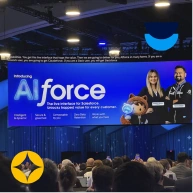
Dynamic interfaces that can be built based on what a person needs to do at any given moment.
Salesforce wants to reverse that relationship.
AIforce is a new interface layer designed to bring Salesforce intelligence, data, workflows, business logic, permissions, and context into the environments where people and AI agents already work.
This means that interacting with Salesforce no longer needs to begin inside a traditional CRM interface.
It could begin in Slack, through an AI agent, inside another application, or from an AI-powered interface.
Behind that interaction, Salesforce continues to provide the business data, rules, permissions, automations, and processes that organizations depend on.
This represents a move toward what Salesforce calls live interfaces: dynamic experiences that can be generated based on what someone needs to accomplish at a particular moment.
The concept is important because it changes the question from:
“How do I access Salesforce to complete this task?”
To:
“How can Salesforce help me complete this task wherever I am already working?”
Claudeforce, Slackforce, and Agentforce Coworker: Different Experiences Powered by AIforce
One of the keys to understanding AIforce is recognizing that it is not a single application.
Salesforce introduced it as a layer capable of extending its data, processes, and capabilities into different work environments.
At Dreamforce 2026, this strategy took shape through three major experiences: Claudeforce, Slackforce, and Agentforce Coworker.
Claudeforce: Salesforce Comes Directly to Claude
Claudeforce emerged from the expanded partnership between Salesforce and Anthropic.
Its goal is to combine Claude’s reasoning capabilities with Salesforce data, workflows, permissions, and enterprise governance.
One of the first experiences is Salesforce in Claude, which allows users to perform Salesforce-related tasks directly from Claude.
For example, a sales representative could prepare for a customer meeting, analyze the sales pipeline, or work with CRM information without constantly switching between applications.
The distinction between this integration and simply uploading business information into an AI tool is important.
The integration is designed to preserve the permissions, controls, and business context established in Salesforce.
This makes Claude another interface for interacting with Salesforce and illustrates the vision behind AIforce: employees no longer need to go to the CRM because CRM capabilities can accompany them into the tools they already use.
Agentforce Coworker: An AI Teammate Inside Salesforce
At the other end of the experience is Agentforce Coworker, an autonomous AI teammate integrated directly into Salesforce.
Coworker can retrieve information from the CRM, Slack, and other connected sources, analyze it, and, when asked to perform a task, create a plan and execute it using Salesforce flows and specialized agents.
This goes far beyond answering questions.
A user could ask Coworker to analyze accounts, opportunities, or open service cases, identify issues requiring attention, and help execute the necessary actions.
Coworker also inherits Salesforce configurations, workflows, metadata, permissions, and governance rules.
According to Salesforce, it can connect to more than 300 enterprise data sources and serve as an entry point to other agents created within an organization.
For Caribbean businesses operating across different markets and serving multilingual customers, these developments could make AI-powered business operations increasingly accessible.
Another relevant advancement is the expanded language support for Agentforce Voice, including Spanish and Portuguese, which creates additional opportunities for organizations serving diverse customer populations.
Slackforce: Working With Salesforce Without Leaving Slack
The third major experience is Slackforce, which brings Salesforce data, agents, and actions directly into Slack conversations.
Teams can retrieve information, update records, interact with agents, and generate visualizations without leaving the workspace where they already collaborate.
Together, these three experiences illustrate Salesforce’s broader vision: Claude, Slack, and Salesforce itself can become different entry points into the same enterprise intelligence.
Agentforce Evolves: AI Agents That Work for Hours, Days, or Weeks
Agentforce once again played a central role at Dreamforce, but the conversation in 2026 was different.
The focus was no longer simply on creating agents capable of providing accurate answers.
Salesforce introduced capabilities that allow agents to take on more complex responsibilities, pursue objectives over extended periods, develop new skills, collaborate with other agents, and improve their performance.
The company also introduced a portfolio of job-ready agents, designed to perform specific business functions without requiring organizations to build every capability from scratch.
These include specialized agents such as:
- Piper: Focused on developing and qualifying inbound sales opportunities.
- Fin: Designed to resolve complex customer service requests.
- Marshall: Built to support supply chain and back-office processes.
Marshall is particularly interesting because it introduces another dimension of automation. It can understand an administrative process, ask questions to clarify requirements, and help create a deterministic sequence of steps that can later be executed across enterprise systems.
One of the most notable announcements involved long-horizon agents, capable of maintaining objectives over days, weeks, or even months.
For example, a company could assign an agent the objective of recovering at-risk sales opportunities.
The agent could develop a multi-step plan, maintain memory across sessions, respond when an action fails, and request human approval whenever established policies require it.
Salesforce also introduced Agent Optimizer, an agent designed to improve other agents.
It can analyze thousands of production sessions, identify recurring failure patterns, and help develop, test, and prepare improvements.
Additional innovations include AI Skills, which turn repeatable tasks into reusable, governed capabilities, and multi-agent orchestration, which allows a primary agent to coordinate specialized agents to complete more complex requests.
The vision is beginning to look less like having a single AI assistant and more like building a digital workforce composed of specialized agents working alongside employees.
This represents an important evolution for Agentforce.
The question is no longer simply:
“What questions can my AI agent answer?”
It is now:
“What work can I safely delegate to my AI agents?”
For businesses, this opens opportunities in sales follow-up, customer service resolution, e-commerce operations, administrative processes, and workflows involving multiple systems.
The Real Foundation of Enterprise AI: Business Context
One of the most frequently repeated ideas at Dreamforce 2026 was that access to an advanced AI model is not enough.
To make sound business decisions, AI needs to understand context.
Consider a seemingly simple question:
“Can we deliver this order today?”
Answering correctly may require customer information from the CRM, inventory data from an ERP, contractual conditions, commercial policies, conversation history, user permissions, and specific fulfillment rules.
No AI model automatically knows all of this.
That is why Salesforce is placing so much emphasis on trusted enterprise context.
This is where Data 360 plays a fundamental role.
Data 360: Turning Business Data Into Fuel for AI Agents
Dreamforce reinforced a reality that many organizations are discovering as they adopt artificial intelligence: the quality of AI decisions depends heavily on the quality, availability, and context of business data.
Data 360 aims to provide that contextual foundation.
The platform connects information from different sources and transforms it into useful intelligence for customers, employees, automations, and AI agents.
This is particularly important for organizations where customer information is distributed across CRM systems, e-commerce platforms, ERP solutions, mobile applications, customer service systems, and marketing tools.
An AI agent may be extremely advanced, but if it does not know that a customer made a purchase yesterday, has an unresolved complaint, or belongs to a specific customer segment, its decisions will be incomplete.
This challenge is especially relevant for Caribbean businesses operating across multiple islands, countries, branches, or customer service channels.
Organizations may manage customer relationships in one system, billing in another, and marketing activities through separate platforms.
A unified data strategy can help connect these environments and provide a more complete understanding of customers.
One of the clearest conclusions from Dreamforce 2026 is therefore simple:
A successful enterprise AI strategy must also be a data strategy.
Koa: Salesforce Introduces an AI Model Specialized in CRM
Another announcement that attracted considerable attention was Koa, Salesforce’s first reasoning model designed specifically for CRM.
Koa was developed in collaboration with NVIDIA using the Nemotron architecture and subsequently trained using accumulated knowledge about business processes and CRM scenarios.
The concept behind Koa is particularly interesting.

Koa showed improvements in context retention, response relevance, and accuracy in selecting tools to perform actions.
General-purpose AI models know a great deal about many subjects. However, correctly executing a sales or service process requires understanding specific business concepts.
For example:
- How does a sales opportunity progress through a pipeline?
- What does it mean to escalate a customer service case?
- When should a sales representative follow up?
- Which action should be executed within a particular workflow?
Salesforce used synthetic scenarios inspired by decades of CRM experience to specialize the model without using private customer data for that training.
According to internal evaluations published by Salesforce, Koa demonstrated improvements in context retention, response relevance, and accuracy when selecting tools to execute actions.
This points toward another important trend: not every enterprise task will require the same AI model.
In some situations, large general-purpose models will be appropriate. In others, specialized models may provide better performance, lower costs, or greater operational control.
Enterprise AI Harness: Giving AI More Autonomy Without Losing Control
As AI agents become increasingly autonomous, an important question emerges:
How can organizations allow AI to act while maintaining security, governance, and control?
Salesforce’s answer is the Trusted Enterprise AI Harness.
This architecture is designed to surround AI models and agents with the enterprise capabilities required for reliable operations.
Salesforce organizes it around six elements:
- Trusted Context: Reliable, contextualized enterprise information.
- Trusted Agency: Agent reasoning, planning, memory, and coordination.
- Trusted Action: Secure connections to applications, APIs, workflows, and business processes.
- Trusted Governance: Policies, data quality, lineage, and governance controls.
- Trusted Security: Identity, permissions, privacy, and protection.
- Trusted Models: The ability to select different AI models according to specific business needs.
This architecture also includes an AI Control Plane designed to provide visibility into the agents operating within an organization, their capabilities, performance, and associated costs.
For large organizations, this could become one of the most important developments introduced at Dreamforce 2026.
Creating an AI agent can be relatively straightforward.
Managing dozens or hundreds of agents that interact with sensitive information and execute real business actions is an entirely different challenge.
For businesses in regulated industries such as financial services, telecommunications, insurance, and healthcare, governance and security are essential considerations when evaluating enterprise AI adoption.
Slack Becomes an Entry Point to the Agentic Enterprise
Slack was another major focus of Dreamforce 2026.

Slackforce: the interface where people, information, and agents can work together.
Salesforce is increasingly positioning Slack not simply as a communication platform, but as an environment where people, information, and AI agents work together.
This vision is reflected in Slackforce.
The reasoning is straightforward.
Much of everyday business activity takes place through conversations.
Someone identifies a problem, asks a colleague for information, searches for relevant data, makes a decision, and then accesses another system to execute an action.
With AI agents connected to enterprise context, many of those steps can happen within the same conversation.
An employee could retrieve customer information, request an analysis, create a sales opportunity, update a service case, or launch a workflow without leaving Slack.
The objective is to reduce the distance between conversation, decision-making, and action.
For organizations with distributed teams across the Caribbean, this approach could simplify collaboration between sales, service, operations, and management teams working from different locations.
Marketing Enters the Age of AI Agents
Dreamforce 2026 also demonstrated how this transformation will extend into Marketing Cloud.
One of the most interesting announcements was Campaign Agent, designed to function as a digital campaign manager.
It can understand campaign objectives, brand guidelines, and business rules to help create content, build audiences, organize customer journeys and communication channels, and optimize marketing activities.
The distinction between this approach and traditional AI-generated content is significant.
It is no longer just about asking AI to write five email subject lines.
The vision is for an agent to understand the overall objective of a campaign and participate in its execution.
This development also comes at a time when consumers are changing how they discover products and brands.
Increasingly, purchasing journeys begin within AI-powered tools capable of interpreting, comparing, and recommending information.
For marketing teams, this makes personalization, customer data, and accurate brand representation increasingly important.
In the Caribbean, where companies may serve audiences with different languages, preferences, and purchasing behaviors, AI-powered marketing could create opportunities to deliver more relevant and consistent customer experiences across markets.
An Open Ecosystem: NVIDIA, AWS, Google Cloud, Anthropic, and OpenAI
Another important message from Dreamforce 2026 was that Salesforce does not intend to build the Agentic Enterprise as a completely closed ecosystem.
During the event and the surrounding weeks, Salesforce announced or expanded collaborations with companies including NVIDIA, AWS, Google Cloud, Anthropic, and OpenAI.
These partnerships allow organizations to combine different technologies and AI models according to their requirements.
For example, the collaboration with AWS aims to make Salesforce information and actions accessible within AWS tools, while AWS agents can participate in experiences within Slack.
The partnership with NVIDIA enabled the development of Koa.
Integrations with other AI model providers reinforce a fundamental idea: organizations will likely operate with multiple models and agents rather than relying on a single solution.
As a result, technologies and standards that connect, govern, and coordinate these components will become increasingly important.
AgentExchange: A Marketplace for the New AI Agent Economy
If organizations are going to work with dozens of AI agents, skills, integrations, and models, Salesforce also needs to make it easier to discover and deploy them.
That is where AgentExchange comes in.
AgentExchange is evolving into a unified marketplace that brings together the traditional AppExchange ecosystem, Slack solutions, and new capabilities developed for Agentforce.
The platform brings together more than 13,000 agents, applications, tools, MCP servers, and partner solutions within a single ecosystem.
However, the transformation involves more than consolidating marketplaces.
AgentExchange incorporates semantic search to understand what a company is trying to accomplish and recommend relevant solutions.
It can also integrate directly with Agentforce Builder to suggest agents, skills, and tools while developers are building an agent.
Support for the Model Context Protocol (MCP) also makes it possible to connect external tools and expand the capabilities available to AI agents.
For businesses, this could significantly reduce the time required to move from an idea to a working implementation.
Instead of developing every capability from scratch, organizations can combine existing agents, applications, integrations, and skills and adapt them to their processes.
For the Salesforce partner ecosystem, this represents another important evolution.
Value will increasingly come from selecting, integrating, customizing, and governing an ecosystem of agents and tools, in addition to developing entirely new solutions.
Headless CRM: Salesforce Moves Beyond the Traditional CRM Screen
If we had to select one idea that summarizes Dreamforce 2026, it might be this:
Salesforce wants organizations to use Salesforce capabilities without necessarily being inside Salesforce.
Headless architecture allows CRM data, actions, automations, and capabilities to be exposed through external interfaces.
Dreamforce 2026 introduced a more concrete name for the architecture supporting this vision: Headless Toolkit.
This set of tools enables Salesforce capabilities to be exposed through APIs, MCP (Model Context Protocol), and command-line interfaces.
As a result, external applications, AI agents, and other experiences can access Salesforce data, business logic, and automations without depending on the traditional CRM interface.
This has important implications for developers and businesses working with different AI platforms.
Instead of creating a completely separate integration for each experience, enterprise capabilities can be designed once and reused across different environments.
Another component is the Headless Experience Layer (HXL), which allows developers to create interactive visual components, such as forms, charts, and widgets, and display them across different interfaces while maintaining Salesforce security and governance rules.
In this way, headless CRM goes beyond simply accessing data from another system.
It means bringing Salesforce data, actions, logic, and even complete visual experiences into the environments where employees and AI agents need to work.
AIforce takes this vision even further.
In a world powered by AI agents, the traditional application interface is no longer the only entry point to enterprise software.
CRM remains essential because it contains information about customers, relationships, processes, and operations.
What changes is how people and AI agents interact with it.
This transformation could eventually become as significant as the transition from installed enterprise software to cloud-based applications.
From AI Experimentation to Measurable ROI
Dreamforce 2026 also reflected an important change in how organizations are evaluating artificial intelligence.
The business conversation is moving beyond experimentation.
Companies increasingly want to understand how much work they can automate, how much time they can save, how many customer requests they can resolve, and how much additional revenue they can generate.
Salesforce highlighted examples such as Live Nation, where Agentforce can automate hundreds of thousands of fan inquiries annually, and SaaStr, which reported sales opportunities and millions of dollars in revenue and pipeline associated with its use of AI agents.
The message for businesses is clear:
Implementing AI simply because it is innovative is no longer enough.
Projects need clearly defined use cases, measurable performance indicators, and business results.
Organizations should evaluate AI investments based on their ability to improve productivity, customer satisfaction, operational efficiency, and revenue generation.
What Does Dreamforce 2026 Mean for Caribbean Businesses?
At Xentric 360, we believe this is one of the most important questions emerging from Dreamforce 2026.
The innovations presented at the event may seem like technologies designed primarily for large Silicon Valley corporations.
However, many of the challenges they address are also present in businesses across the Caribbean.
Sales teams spend too much time on administrative tasks.
Customer service departments handle large volumes of repetitive inquiries.
Customer information is distributed across disconnected systems.
Manual processes create inefficiencies between sales, service, marketing, and operations.
Marketing campaigns still require considerable operational effort.
And many organizations want to adopt artificial intelligence but are unsure where to begin.
These challenges are relevant across industries such as banking, insurance, telecommunications, tourism, hospitality, retail, distribution, and professional services.
For businesses operating in Jamaica, Puerto Rico, the Dominican Republic, Trinidad & Tobago, and other Caribbean markets, digital transformation also presents opportunities to improve regional coordination, customer engagement, and operational consistency.
The opportunity does not necessarily involve implementing every innovation announced at Dreamforce.
Instead, organizations should identify the business processes that create the greatest friction and determine which ones could benefit from automation.
They should also understand what information AI systems need to perform those tasks reliably.
In some cases, the first step will be organizing customer data.
In others, it will involve connecting existing systems.
For some organizations, the priority may be automating customer service with Agentforce.
For others, the greatest opportunity may lie in improving sales performance, marketing operations, commerce, or internal productivity.
Technology should always begin with a business problem worth solving.
Dreamforce 2026 Introduces a New Definition of CRM
For years, CRM primarily meant managing customer information and relationships.
Dreamforce 2026 significantly expanded that definition.
CRM is increasingly becoming the contextual foundation that allows artificial intelligence to understand how a business operates.
Data 360 provides information and context.
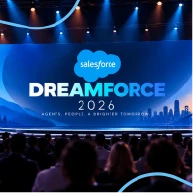
The CRM is beginning to serve as the context that enables an artificial intelligence to understand how a company functions.
Agentforce introduces AI agents capable of reasoning and taking action.
Koa adds intelligence specialized in CRM processes.
Slack creates an environment where people and AI agents collaborate.
AIforce extends Salesforce capabilities into new interfaces.
And the Enterprise AI Harness provides the governance and security framework needed to connect these components.
Viewed together, the announcements from Dreamforce no longer appear to be a collection of independent products.
They represent components of a broader enterprise architecture.
Perhaps the most important conclusion from Dreamforce 2026 is that Salesforce is not simply adding artificial intelligence to CRM.
It is transforming CRM, enterprise data, and business processes into the foundation from which AI can perform meaningful work.
For organizations across the Caribbean, getting started does not mean deploying dozens of AI agents tomorrow.
It means identifying processes that could benefit from this new way of working, preparing the data that will provide the necessary context, and developing an AI strategy that can grow securely and sustainably.
Bring Salesforce Innovation to Your Business With Xentric 360
As an Authorized Salesforce Reseller in the Caribbean, Xentric 360 helps organizations understand which Salesforce solutions best address their business needs and connects them with certified partners for implementation, training, and consulting.
Founded in December 2021, Xentric 360 supports digital transformation across the region, with offices in Jamaica, Puerto Rico, the Dominican Republic, and Trinidad & Tobago.
Our regional presence allows us to provide personalized attention, first-level Salesforce support, and local billing and payment options that simplify the purchasing process for customers.
We understand the business environments, cultures, and opportunities that make Caribbean markets unique.
Our goal is to help organizations unlock the value of Salesforce and build stronger customer relationships through technology.
Dreamforce 2026 showed us where Salesforce is heading.
Now the challenge is to turn that innovation into measurable results for your business.
Ready to explore what Salesforce AI can do for your organization? Contact Xentric 360 and discover how we can help you take the next step in your digital transformation journey.
Si tienes preguntas sobre algún producto de Salesforce, no dudes en contactarnos.